 Skip to content

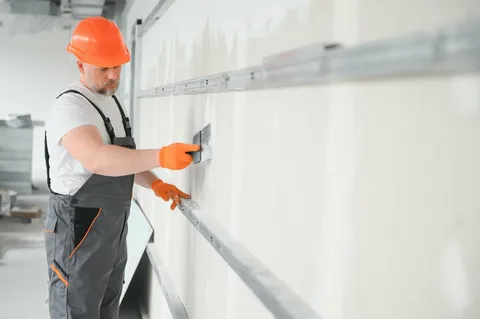
Edmonton’s commercial construction and renovation sector operates under conditions that demand technical precision. Cold climate construction, Alberta Building Code compliance, tight project timelines, and the performance expectations of office tenants, retail operators, and property managers all converge on a single interior system: drywall. Understanding what professional commercial drywall and renovation services in Edmonton actually involve — and why contractor selection determines project outcomes — helps business owners and property managers make informed decisions before a project begins.
What Separates Commercial Drywall from Residential Work
Commercial drywall is a distinct discipline. The scale, timeline pressure, material specifications, and code requirements that govern commercial interior construction have no equivalent in residential projects.
In commercial environments, steel stud framing replaces wood almost entirely. Steel studs provide dimensional stability, fire resistance, and compliance with National Building Code requirements for non-combustible construction in most commercial occupancies. Precise steel stud layout is not simply a structural matter — it determines how drywall panels align with mechanical, electrical, and plumbing rough-ins, directly affecting the finishing timeline.
Fire-rated assemblies are a defining feature of commercial drywall work. Corridor walls, stairwell enclosures, and tenant demising walls in Edmonton commercial buildings typically require UL-listed or CAN/ULC-rated assemblies that specify panel type, stud gauge, fastener pattern, and the number of drywall layers. A contractor unfamiliar with rated assembly requirements cannot execute this work correctly.
Acoustic performance is equally important in commercial renovation. Open-plan offices converted to private suites, medical clinics, legal offices, and educational facilities all require partition assemblies engineered to achieve specific Sound Transmission Class (STC) ratings. This involves decoupled framing, acoustic insulation, and resilient channel systems — components that add cost but are non-negotiable for occupant function and comfort.
Core Services in Commercial Drywall and Interior Renovation
A full-scope commercial drywall and renovation contractor in Edmonton delivers an integrated set of services that cover the interior construction cycle from structural framework to finished surface.
Steel stud framing establishes the internal geometry of a commercial space. Framing crews interpret architectural drawings, coordinate with mechanical and electrical trades, and construct partition layouts that satisfy both design intent and code requirements. Errors at the framing stage propagate through every subsequent trade.
Drywall installation requires more than hanging panels. Board selection — standard gypsum, moisture-resistant, mold-resistant, fire-rated, or impact-resistant — must match the functional demands of each space. Mechanical rooms, commercial kitchens, healthcare environments, and high-traffic corridors each call for different panel specifications.
Taping and finishing is the craft element of commercial drywall. A Level 5 finish — the standard required under critical lighting in corporate office and retail environments — demands multiple compound coats, precise feathering, and a skim coat or paint primer application that leaves no tool marks, ridges, or joint shadows visible under direct light. This is the stage that separates experienced finishers from generalist contractors.
T-bar and suspended ceiling systems are an integrated component of most commercial renovation projects. Grid ceiling installation must coordinate with HVAC diffuser locations, light fixture layouts, sprinkler heads, and access requirements for mechanical systems above the ceiling plane.
Insulation within commercial partitions serves thermal, acoustic, and fire-containment functions. Batt insulation selection and installation in commercial assemblies follows specific requirements that differ from residential practice, particularly in fire-rated and acoustically rated wall systems.
Interior renovation scope extends beyond new construction. Existing commercial spaces undergoing tenant improvement, office reconfiguration, or change of use require selective demolition, patching of existing drywall assemblies to match level of finish, and integration of new partitions with legacy construction — work that tests a contractor’s adaptability and problem-solving capability.

Edmonton-Specific Considerations for Commercial Renovation
Edmonton’s climate introduces variables that affect both scheduling and material performance. Interior renovation work in commercial buildings during winter months requires controlled site temperatures for drywall compound to cure correctly. Compound applied in spaces below 13°C fails to dry uniformly, producing finish defects that only become visible after painting — requiring costly remediation.
Alberta’s commercial construction market also operates within a specific regulatory environment. Permits for tenant improvement and interior renovation in Edmonton require compliance with the Alberta Building Code, National Building Code adoption amendments, and where applicable, specific requirements of the Edmonton Zoning Bylaw for occupancy classification changes. A contractor experienced in Edmonton’s commercial sector understands this permitting landscape and can coordinate with project consultants accordingly.
Evaluating a Commercial Drywall Contractor in Edmonton
Contractor selection for commercial drywall and renovation should be based on documented competency, not price alone. Verified experience with fire-rated assembly construction, demonstrated knowledge of Level 5 finishing standards, and the ability to coordinate efficiently with other trades on an active commercial site are the benchmarks that determine whether a project finishes on schedule and within budget.
The right commercial drywall and renovation contractor brings framing, installation, finishing, and ceiling systems under a single scope of responsibility — reducing coordination gaps between trades and ensuring that interior construction quality meets both code requirements and the expectations of commercial occupants.
Conclusion
Commercial drywall and renovation in Edmonton is a technically demanding field that requires contractors with genuine expertise in steel stud framing, fire-rated assemblies, acoustic systems, and high-level finishing. For business owners and property managers planning interior renovations, tenant improvements, or new commercial fit-outs in Edmonton, selecting an experienced contractor with a proven commercial portfolio is the decision that most directly determines project success.
From initial framing through final finish, the quality of interior construction defines how a space performs and how long it serves its occupants without requiring costly remediation.
